Search This Blog

Saturday, November 9, 2019

Classical versus Quantum Photons

Einstein was the first to explain the electric impulses of the photoelectric effect as a quantum consequence of single photons in 1905. Although Planck had some years earlier in 1900 proposed the notion of a quantum of light to explain the nature of blackbody emission, it was Einstein who first recognized the quantum nature of light photons as particles in the photoelectric effect. Light made up of finite photon particles instead of the classical determinism of infinitely divisible light waves birthed the uncertainty of discrete quantum mechanics.

Classical physics had long accepted the notion of light as an infinitely divisible wave and then quickly adapted to the semiclassical notion of light as a large number of single photons or electromagnetic pulses in time and space. However, even such a semiclassical photon of light shows the uncertainty principle and so photons are not subject to classical determinism. Rather, a single quantum photon obeys the quantum uncertainty of superposition of many paths, polarizations, and energies. Specifically, while classical determinism argues that a classical single photon particle can only be on one path at a time with well-defined polarization, frequency, and location and all simultaneously knowable to arbitrary precision.

The single quantum photon exists instead with an uncertain outcome as a superposition of paths, polarizations, and frequencies. As a result, there is a well-defined limit to the precision of any simultaneous single photon measurement of path, polarization, and frequency. Nevertheless, many of the semiclassical notions of a photon survive and result in much quantum confusion that precludes determinate outcomes.

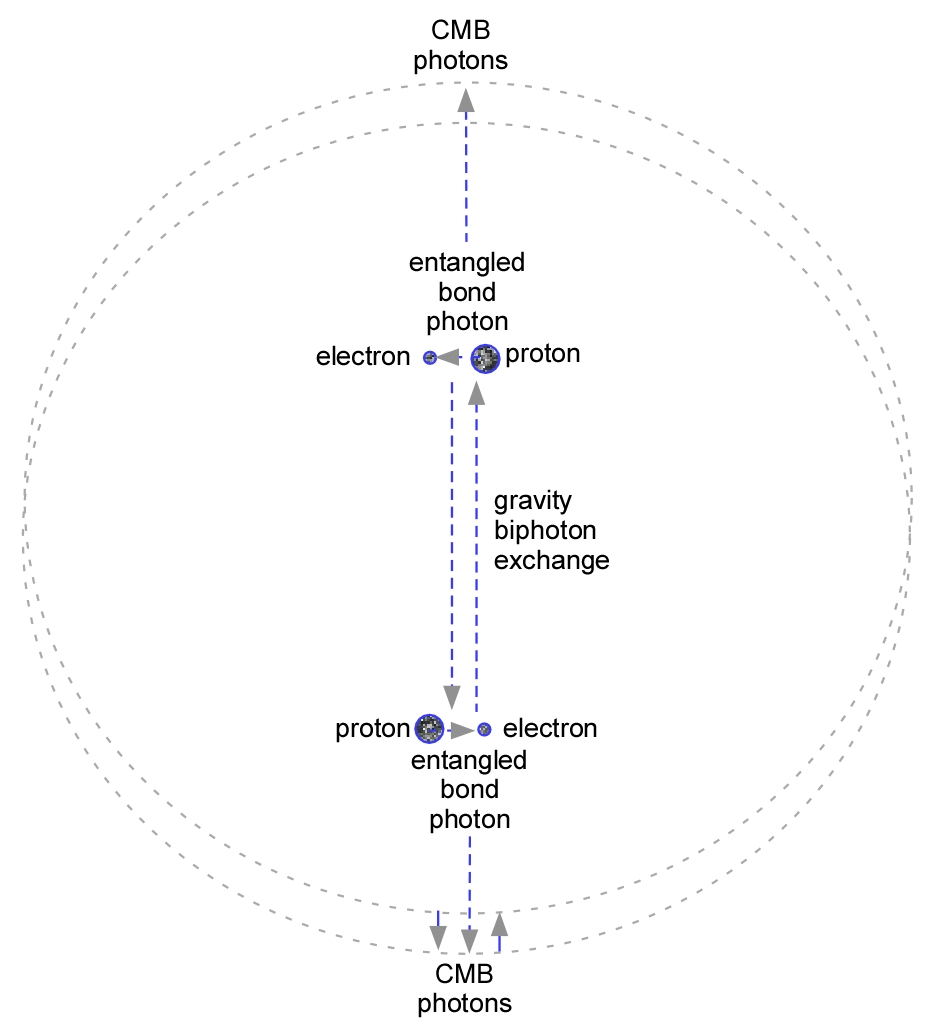
Photon exchange is the basic quantum glue that bonds all matter together and photon exchange is what bonds both charge and gravity matter. The outcome of a photon precursor is a quantum bonding state between emitter and absorber matter. While single photon exchange bonds charge matter by exchange and complementary ephoton mission, biphoton exchange bonds gravity matter by the complementary exchange and emission of biphotons.

A photon is an electromagnetic pulse that has a spectrum of frequencies in its Fourier transform. This fundamental relation between time and frequency is the foundation of the uncertainty principle. A short pulse of light is made up of a broad frequency spectrum and a long pulse of light is made up of a correspondingly very narrow spectrum. Thus a photon is a fundamentally quantum object that can nevertheless behave like a classical particle of matter under certain conditions. A classical particle of matter has a well defined path, mass, polarization, and location and a particle of matter can behave like a photon under certain conditions as well.

A charge bond is a photon exchange with complementary emitted photons since it is necessary to lose heat to bond charges. A gravity bond is a biphoton exchange that also has a complementary emitted biphoton since it is also necessary to lose heat to bond gravity matter. As a result of quantum gravity, atomic hydrogen can exist as a cold vacuum lattice cloud. As the cloud density grows with more and more cold hydrogen, eventually molecular hydrogen forms and the lattice spacing decreases until it nucleates. At this point, there is a transition from gravity to charge dispersion and nascent stellar binary nucleates condense with orthogonal spins. One-half of the cloud lattice collapses into one spin while the other half collapses into the orthogonal spin.

Quantum gravity bonds form and emit heat in a concerted spiral of condensation in the nuclei of molecular clouds. However, quantum gravity biphotons are 1e-39 less than quantum charge photon and so represent a virtual continuum of spiral states with orthogonal spins. While one spin condenses with like spins into one spiral, the orthogonal spin condenses with complementary spins into the complementary spiral of a stellar binary. It is important that the stellar nuclei continue to lose heat as the molecular cloud collapses with radial accretion. Heat loss occurs from hot axial jets that result from the cold radial accretion until fusion eventually ignites the stellar nuclei into nascent stars.

Once again, there is really no such thing as a classical photon because a photon is a pure quantum manifestation. Complementary to an atom as a discrete quantum of matter that is a superposition of electrons and protons, a photon is a discrete electromagnetic quantum that is a superposition of frequencies, polarizations, paths, and locations. However, there are various semiclassical simplifications for a photon that people find useful in certain contexts just as there are for atoms. For example, a simplified semiclassical photon may have a single frequency even though a quantum photon is always a spectrum of frequencies and never a single frequency.

A semiclassical single photon may have a single polarization state  even though a quantum photon is always in a superposition of polarizations. A polarized photon will pass an aligned polarizer, which then reflects other polarizations. In contrast, a single quantum photon always exists in a superposition of polarization states until interacting with a polarizer to form a probabilistic polarization for each single quantum photon. Thus a single quantum photon may not have a well-defined polarization state before it interacts with the electrons of a polarizer. Note that a linear polarized single quantum photon is still a superposition of right and left circular polarizations.

A semiclassical single photon has a well-defined pulse path and location and cannot be in two places at the same time. However, a quantum single photon exists as a probabilistic superposition of all locations in the universe. At any given moment, that single quantum photon can exist as any number of paths and locations with various probabilities.

A semiclassical single photon still has a well defined frequency distribution and phase called a spectrum. A semiclassical photon spectrum exists as a Fourier transform of its time pulse and so the photon spectrum relates the time pulse and frequency. A quantum single photon is a superposition of frequencies and phases that are its spectrum and the Fourier transform relates photon pulse and spectrum. The quantum photon spectrum and pulse relationship is the quantum uncertainty principle between time and frequency.

Classically, there is no limit to the precision of simultaneous measurement of a particle momentum and location. A photon, however, has a discrete quantum limit to the precision of simultaneous measurements of both photon frequency and location. As a result, the more localized the photon, the broader the frequency spectrum becomes and eventually, the light wavelength exceeds the apparatus size. At that point, the measurement becomes meaningless.

Likewise, a semiclassical photon may have a well defined average location in time, but a quantum photon is always a distribution of locations, never a single location. A semiclassical photon may have a well-defined single path, but a quantum photon always exists on a distribution of paths, never just a single path. Moreover, matter has the complementary quantum properties of light.

Matter has a well-defined average location in time and matter is stationary while light only moves at a constant speed. Matter also oscillates complementary to light with a distribution of frequencies and also has a distribution of locations about an average location. An atom of matter has an average mass or frequency, but matter is also a distribution of masses about that average mass. While there are fundamental particles with very well-defined rest masses, quantum particles really only have inertial mass complementary to light. Rest mass just represents a particle’s interaction with other matter, which photons of course mediate.

Finally, classical matter has a well-defined average path, but quantum particles exist on a distribution of paths. However, upon interaction with other matter, any such distribution decays very quickly into the one path that we call our rest frame reality.

Tuesday, October 22, 2019

Classical Versus Quantum Narratives

Classical versus quantum are really two very different but still related narratives that underpin physical reality. While our macroscopic reality is very classical, our microscopic reality is quantum and so the two narratives derive from the very different natures of our macroscopic versus microscopic realities. Classically, the visual, audio, touch, taste, and odor contrasts of matter motion through space and time define our macroscopic reality, while the quantum amplitude and phase of much higher resolution spectra refine our microscopic reality.

In particular, we only sense a very low resolution and limited visible light spectrum and do not sense the phase or polarization of that light at all and there are similar low resolution spectra for all of our other senses as well. These low resolution spectra contrast with the very high resolution spectra that science records from many different devices. Science measures light, sound, impulse, chemistry, and odor not only at other vastly different wavelengths, but also at much higher resolution that also include phase as well as wavelength in its spectra. While there is a great deal of overlap between our macroscopic and microscopic narratives, there are many dramatic differences as well.

In our macroscopic reality, matter does not appear to exist in the same exact place at one time nor does the same matter appear to exist in more than one place at a time, either. Classically there are knowable precursors for every outcome in spite of the fact that we might not know those precursors because they might be hidden or otherwise obscured by noise. In other words, there is no classical limit to the precision of our knowledge of classical precursors despite the noise.

In our microscopic reality, though, matter can exist in the same exact place and time as other matter and the same matter can also exist in more than one place at a time as well. This is simply a consequence of quantum superposition and entanglement and does not violate causality. Thus there are still quantum precursors for every quantum outcome, but we may not be able to precisely know or measure those quantum precursors. Unlike the unlimited precision of classical knowledge, there is a discrete quantum limit to the precision of our knowledge of quantum precursors.

In both classical and quantum narratives, a pulse of light exists with both an average frequency as well as an instantaneous amplitude versus time and amplitude versus frequency. In addition, a pulse of light also has a single classical polarization state, but always a quantum superposition of two orthogonal polarization states. While a classical light pulse exists with a single well-defined polarization state, a quantum light pulse exists in a superposition of two orthogonal polarization states.


Therefore a single quantum photon always exists as a superposition of polarizations in contrast to a single classical photon that only exists with a well-defined single polarization. It is not possible to reconcile the notions of non oscillating classical matter with the oscillation of classical light. This represents the irreducible conundrum of classical versus quantum narratives. While a pair of correlated oscillating quantum states can represent a classical state, there is no classical representation for a single quantum state.

The quantum gravity biphoton reconciles classical determinate gravity relativity with the discrete uncertainties of quantum charge. While the photon-matter exchange of charge is necessarily quantum, biphoton-matter exchange is classical because of the entanglement and symmetry of quantum phase. Unlike the microscopic single photon exchange of charge with uncertain outcomes, the macroscopic biphoton exchange of gravity occurs with the determinate outcomes of universe change. The uncertainties of quantum gravity only show up at the scale of the universe while the uncertainties of atomic charge show up at the atomic scale.

Thursday, October 10, 2019

Fast Changes versus Slow Changes

There is a fundamental confusion between very fast changes and very slow changes in the universe. There are two very different clocks for slow versus fast changes even though mainstream science believes that there is still only one time dimension. While the universe changes only very, very slowly, atoms and molecules literally change at the speed of light and even the atoms and molecules of rest matter undergo very fast and perpetual changes. What looks like quiescent matter is actually a cauldron of seething electrons, protons, and neutrons in perpetual motion and change and yet on the scale of the cosmos, we sometimes see no change at all.

Mainstream science believes that the very slow changes in the universe are simply manifestations of the very fast atomic changes of a single time dimension. This is not correct. While atomic clocks show a very precise time for atoms and molecules, the dephasing of two atomic time clocks reveals a second time dimension of very slow universe time. Mainstream science believes the very slow changes in the universe today stem from the very fast changes of a big bang followed by another whole universe of very fast changes known as inflation. Finally, the very slow changes we see today just derive from the CMB (cosmic microwave background) creation.

However, there is no sense to what caused the big bang and there are over twenty fundamental particles and constants as well as their antimatter equivalents and those constants have existed since just after the very fast changes of the big bang and inflation. Thus, the patchwork belief of mainstream is a narrative of a very slow universe changes evolving from very fast matter action. In fact, mainstream science must believe in an origin along with a large number of particles, constants, and other leaps of faith to make sense out of the very slow changes that we see today in the universe.

Mattertime is an alternative belief that still makes sense out of the CMB creation and that there are actually two time dimensions; the very fast atom changes result in an atomic clock and the very slow universe changes of the dephasing of two atomic clocks . Mattertime is a very simple alternative belief that is also consistent with all observations and in fact, mattertime simply reinterprets many observations of matter decay and force growth that the mainstream attributes to other things or can't otherwise explain.

Mattertime expresses all change with just two quantum dimensions or conjugates of matter and action which along with quantum phase complete the trimal of quantum change.

There are just two mattertime constants and all other constants and particles emerge from just these two. Of course, the two mattertime constants, aether particle mass and action, are just simplifications of all spacetime constants and particles. All matter including even space and time and black holes emerges from the actions of aether particles and the fundamental quantum Schrödinger equation.

The Planck constant, h, is the action constant of light since it gives the energy of each photon of light from the light's oscillation frequency. Since photon exchange bonds all matter, h is  a part of all matter, not just light. Likewise, hae = h/c2 is the action constant of mattertime since it relates an equivalent mass to any action oscillation frequency. All quantum aether oscillates and the relative phases of matter's quantum oscillations are what either bonds or scatters matter with aether exchange. This means that each photon of light is actually a bound aether pair and the photon energy is equal to the strength of that bond.

The aether particle mass is the second mattertime constant and is simply the fraction of hydrogen atom action mass, hae/tB, due to gravity versus charge, forcecharge/forcegravity. The ratio of the Planck constant, hae, to Bohr hydrogen orbit period, tB, is the mass equivalent bonding energy of a hydrogen atom and so the aether particle mass is then the matter equivalent bonding energy of the universe to itself.

The incredible and complex universe emerges from the very simply building blocks of matter and action along with the quantum Schrödinger equation. The universe is really a causal set of precursors for every outcome and our own purpose and meaning emerge from that family relationship. However, since we ourselves are all causal sets embedded within the universe causal set, there are limits to what we can know about precursors of outcomes. This limitation is enshrined in something called the quantum uncertainty principle and is really a direct outcome of the nature of quantum phase.

Fundamentally, we are quantum beings with matter, action, and phase in a perpetual oscillation embedded in the quantum matter, action and phase of the universe. The fact that we cannot know our quantum phase limits how well we can know other quantum phase and that limits the precision of our knowledge of matter action. While we can predict matter action quite well, there is a fundamental mystery of matter action in which we must simply believe.

Mattertime is completely consistent with the matter-energy equivalence of gravity relativity since all energy is a form of aether in mattertime. In fact, the entire universe is made up of matter action and time and space and black holes all emerge from matter action and phase. Therefore, mattertime includes quantum gravity and gravitons become the biphotons of CMB creation. The dark biphotons of gravity waves are the glue that pulls the universe together and there is no need to invent dark matter or dark energy. The mattertime universe already makes sense as a pulse of matter and the fundamental gauge or measure of all action is the aether particle.