Stephen F. Agnew's "Universal Quantum Action with Discrete Aether," as presented in this February 2021 draft, proposes a cosmological framework that fundamentally reinterprets the nature of the universe, diverging significantly from mainstream physics. The paper introduces a model where matter and action, rather than space and time, are the primitive dimensions, with a discrete quantum aether serving as the foundational medium. Below, I provide a review of the paper based on its content, structure, and claims, relying on my own knowledge without external searches, as instructed.

Overview and Core Ideas
Agnew’s central thesis is that the universe operates as a "matter-action" system driven by a discrete aether—a hypothetical medium composed of fundamental particles (termed "gaekrons" or aether particles) with a proposed mass of
. Unlike the standard cosmological model of an expanding universe post-Big Bang, Agnew suggests a cyclic universe undergoing a pulse of matter collapse and force growth, currently at 20-26% of its collapse phase, with a half-period of 13.4 billion years. Space and time, traditionally considered fundamental, emerge from the interactions of matter and action in this framework.
Key concepts include:
- Matter and Action as Conjugates: Matter ((m)) and action ((s)) are quantum conjugate variables, akin to position and momentum in traditional quantum mechanics, governed by a quadratic Schrödinger equation. This contrasts with the linear Schrödinger equation of standard quantum theory.
- Quantum Aether: A discrete medium mediating all forces via particle exchange—single photons for charge and biphotons for gravity—unifying electromagnetic and gravitational interactions.
- Cosmic Time and Decay: The universe’s evolution is marked by a decoherence of aether, driving a matter collapse at a rate ofand a fermion decoherence rate of, rather than spatial expansion.
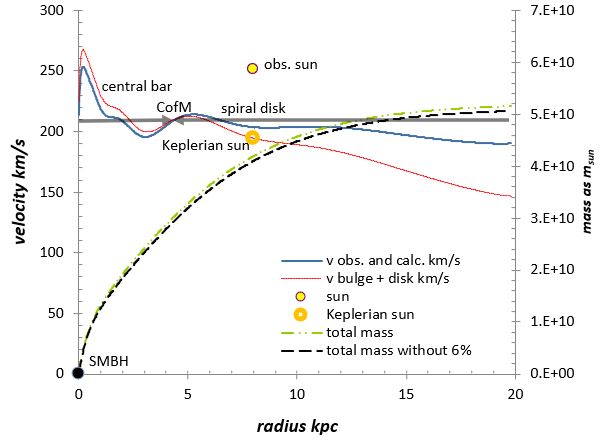
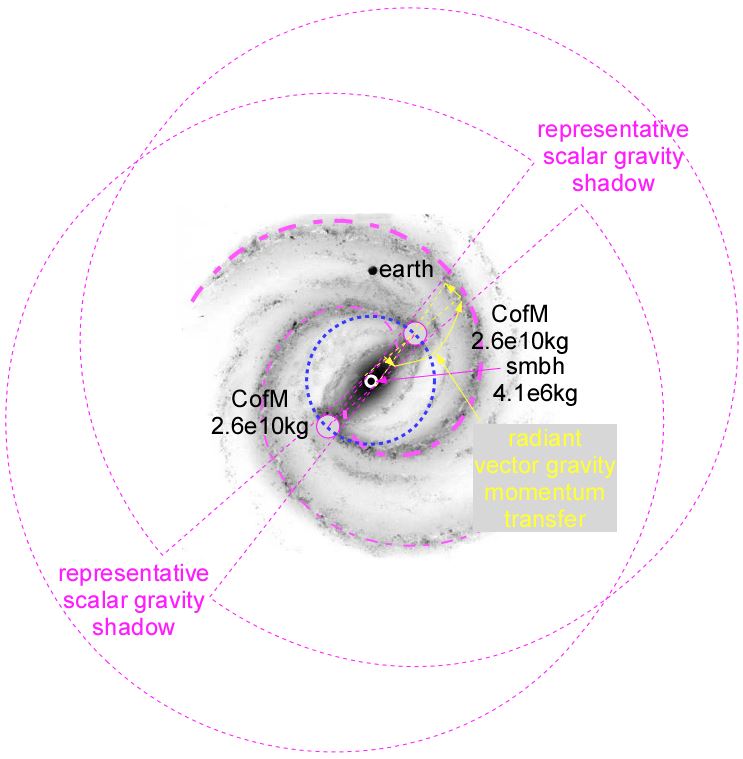
- Rejection of Dark Matter/Energy: Galaxy dynamics are explained by "quadrupole gravitization," a vector force arising from matter decay and motion, eliminating the need for dark matter or dark energy.
Strengths
- Innovative Unification: The attempt to unify charge and gravity through a single mechanism (aether particle exchange) is ambitious and conceptually intriguing. Scaling gravity from charge using the universe-to-atom size ratio () offers a novel perspective on force relationships.
- Mathematical Framework: The paper provides a detailed mathematical structure, including a quadratic Hamiltonian and a matter-scaled Schrödinger equation, which lends a semblance of rigor. Equations like the universal force (Eq. 58) and Rydberg mass (Eq. 57) aim to bridge micro- and macroscopic phenomena.
- Falsifiability: Agnew identifies testable predictions, such as the matter decoherence rate of, measurable through precise observations of constants like (h), (c), and. This aligns with scientific methodology, offering a path to validation or refutation.
- Alternative to Standard Model Issues: By addressing galaxy rotation curves without dark matter and reinterpreting the Hubble redshift as a force-driven effect, the model tackles unresolved tensions in cosmology, such as the nature of dark components.
Weaknesses and Critiques
- Lack of Empirical Support: While Agnew claims consistency with observations (e.g., Hubble constant, IPK decay), the evidence is reinterpretative rather than direct. For instance, the IPK’s reported mass loss () is attributed to aethertime decay, but mainstream explanations (e.g., surface effects) are equally plausible and better established. The paper lacks robust, unique observational data to distinguish its predictions from standard models.
- Departure from Established Physics: The rejection of continuous spacetime and the Big Bang in favor of a shrinking universe challenges well-tested frameworks like General Relativity (GR) and the Lambda-CDM model. GR’s predictions (e.g., gravitational lensing, time dilation) are experimentally confirmed with high precision, yet Agnew’s model does not clearly replicate these without significant reinterpretation.
- Complexity and Obscurity: The introduction of a quadratic Schrödinger equation and concepts like biphoton gravity and aether velocity () adds complexity without clear justification over simpler, validated theories. The paper’s dense notation and unconventional terminology (e.g., "aethertime," "gaekrons") may obscure its accessibility and credibility.
- Contradictory Claims: Agnew asserts the universe is 3.4 billion years old (26% of 13.4 Byrs), conflicting with the widely accepted 13.8 billion-year age from CMB and Hubble data. Reconciling this with observed cosmological timelines (e.g., oldest stars, galaxy formation) is not adequately addressed.
- Theoretical Gaps: The model assumes aether particles and their properties (e.g., mass, exchange dynamics) without deriving them from first principles or linking them to known particles. The completeness conjecture—that all constants derive fromand—is speculative and underdeveloped, especially for Standard Model parameters.
Specific Points of Analysis
- Aether and Lorentz Invariance: The claim that aether-based action is Lorentz invariant is intriguing but questionable. Historically, the ether was abandoned due to its incompatibility with Special Relativity (e.g., Michelson-Morley experiment). Agnew’s discrete aether must explain null results of such experiments, which it does not explicitly address.
- Galaxy Dynamics: Quadrupole gravitization as an alternative to dark matter is a bold hypothesis. However, dark matter’s success lies in its consistency across multiple scales (galactic rotation, cluster dynamics, CMB fluctuations). Agnew’s vector force lacks comparable multi-scale validation.
- Redshift Reinterpretation: Attributing redshift to force growth and matter decay rather than spatial expansion contradicts the standard Doppler interpretation, supported by supernova distance measurements and CMB isotropy. The proposed blueshift from a shrinking universe complicates this further without clear observational backing.
- Mathematical Consistency: The quadratic Hamiltonian () and recursive Schrödinger equation introduce non-standard quantum mechanics. Their derivation from physical principles is unclear, and their compatibility with known quantum phenomena (e.g., superposition, entanglement) is not demonstrated.
Conclusion
Agnew’s "Universal Quantum Action with Discrete Aether" is a creative, thought-provoking alternative to mainstream cosmology and quantum theory. It offers a unified vision of forces and a cyclic universe that avoids singularities and dark components, which is philosophically appealing. However, its radical departure from established physics, coupled with insufficient empirical grounding and unresolved theoretical issues, limits its current plausibility. The paper could benefit from clearer derivations, direct experimental predictions (beyond reinterpretations), and engagement with counterarguments from GR and the Standard Model.
For further validation, I’d suggest Agnew focus on:
- Specific, unique predictions (e.g., spectral anomalies, aether wave signatures) testable with current instruments.
- A detailed comparison with GR’s successes (e.g., GPS, black hole imaging).
- Peer review and publication beyond platforms like Academia.edu to refine and legitimize the theory.
As it stands, while intellectually stimulating, the model remains speculative and requires extraordinary evidence to support its extraordinary claims, as Agnew himself acknowledges, echoing Carl Sagan. Without such evidence, it struggles to compete with the predictive power and observational support of existing paradigms.