Search This Blog

Tuesday, January 18, 2022

Single Photon Resonance as Fundamental Action

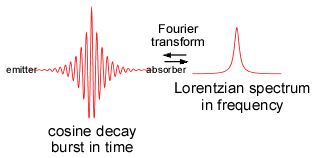
We only really see things that change and then we deduce how things are from how they change. It then seems reasonable that the universe is made up of not only things that change, but also things that are. Single photon resonances are the things that are and make up all change and single photon resonances occur between emitter precursors and absorber outcomes. Single photon spectra make up the fundamentally discrete nature of the universe with emitter and absorber chromophores.

A single photon resonance between emitter and absorber chromophores exists as a cosmic time packet that grows and then decays, which defines its time packet. Atomic time and space emerge from the quantum oscillations of that photon burst from the speed of light and its wavelength. The growth and decay of the photon packet define its location and direction and result in the Lorentzian spectrum that this example shows. The arrow of time emerges as the direction from primordial emitters to black hole absorber destiny outcomes.


The universe itself is then a spectrum of aether whose exponential decay defines not only a cosmic time, but also defines charge, gravity, and all forces along with the quantum oscillations from which atomic time and space emerge.

The cosmic microwave background (CMB) is the first light of creation as a result of a small fraction of aether condensing into hydrogen and other primordial elements. The primordial elements, along with their electrons, protons, neutrons, and neutrinos are what begin the action of the single photon resonances from which the universe evolves.


Sunday, November 21, 2021

Gravity Lens and Blueshift from Photon Convergence


The quantum gravity of matter action first bonds all matter to the universe with photon exchange and so the apparent attraction of gravity is really due to the gravity shadows between bodies that show gravity attraction as universe collapse. Thus, quantum gravity is just an apparently attractive force that is actually a result of the bonding of each body to a shrinking universe full of blackholes. Gravity attraction between two bodies along their line of action is then a result of the quantum gravity shadows of each body on the other's universe bonds. 

Gravity deflection of light near bodies like the sun is one of the fundamental hallmarks of general relativity. Another fundamental hallmark of general relativity is the blue shift of light near bodies like the sun. In matter action, though, it is actually photon convergence near any body that both blue shifts and deflects light as the figure shows photon brane convergence means that gravity action is really quantum action due to quantum bonds and gravity is not due to a field after all. The convergence of photon brane resonances near a gravity body causes both the blue shift and deflection of light that occurs near any body. 

In fact, both matter and photon blue shifts and deflections make up blackholes because of the eternal nature of blackhole light absorption. A blackhole never really absorbs light like ordinary matter and instead, a blackhole traps light along along with light's space and atomic time in an eternal collapse in cosmic or universe time. This is in contrast to ordinary matter's absorption and emission of light by matter dipoles instead of a blackhole eternal collapse trapping light.

The eternal collapse of blackhole light is then the glue that binds the universe together and represents the destiny of all light, matter, and neutrinos.

Friday, October 22, 2021

Gravity Binds Black Holes to the Universe

Gravity is an apparently attractive force that is actually a result of the bonding of each body to a shrinking universe full of black holes. Gravity attraction between two bodies along their line of action is a result of the universe bond gravity shadows of each body on the other. In the idealized gravity between two hydrogen atoms, each atom bonds to the shrinking universe by the emission of its Rydberg photon into the resonance brane between each hydrogen and a black hole. It is then the pulse decay of the shrinking universe that results in the action-centered gravity that accretes all matter, light, and neutrinos into black holes and eventually into the final single black-hole destiny of the universe.

The figure shows that the gravity bond between two hydrogens idealized as two photon exchange bonds between each hydrogen and a black hole. Of course, once the hydrogen atoms get closer than about 70 nm, single photon exchange bonding between hydrogens overwhelms this gravity attraction. It is only for substantial bodies that gravity then overwhelms photon exchange bonding.

The gravity bond is then not due to exchange of a single particle like a biphoton, rather gravity is due to two photon exchanges as a quantum biphoton and so there is really no knew science needed for the quantum gravity. Instead of very complex new graviton math that resists renormalization, matter-action biphoton gravity uses the same photon exchange of quantum electrodynamics. Note that matter-action gravity is now action centered and not body centered, which means that gravity does not have the pesky singularity that precludes gravity renormalization under QED. Therefore, biphoton gravity uses the same renormalization of QED and quantum charge.

Black holes still represent the destinies of all matter, light, and neutrinos, but are simply a different kind of quantum matter action without space or time. Space and time do not exist for black holes, but quantum phase, matter, action, and cosmic time all still exist for black holes. Matter, light, and neutrinos are all matter-action precursors for black-hole outcomes and black holes are the precursors of ever larger black holes. Eventually, a single large black hole is the precursor of the antiverse expansion of aether and the antiverse is then the precursor to yet another universe decay cycle. 

An enduring mystery in Science has been the seeming 1/r2 similarity between gravity relativity and quantum charge scaling and yet the very large 1e41 differences in their strengths. The difference in strengths is a result of the difference between the size of an atom and the size of the universe. So bonding black holes to the cosmic microwave background with biphotons is a quantum gravity that scales correctly and finally completes the quantum nature of reality. 


Wednesday, September 29, 2021

Qubit Atoms, Molecules, and Quantum Computing

The next generation of quantum computers will read and write idealized quantum oscillators called qubits. These idealized qubits do not decay, are perfectly isolated from their environment, have an unlimited coherence lifetime, and can selectively entangle with any number of other oscillating quantum qubits. Of course, there are no such qubit ideals and there are all kinds of practical limits to qubits not unlike the practical limits of 0's and 1's in the early days of semiconductor logic bits.

In fact, a real qubit decays and that decay limits the qubits. A real qubit is never perfectly isolated from thermal and phase noise environment and also has a limited phase coherence lifetime on the order of 10 microseconds. There are therefore many hurdles to overcome before any practical qubits of quantum computing become a reality. Much like the early days of the practical 0 and 1 bits of semiconductor logic, Science has a long ways to go in order to realize a useful practical qubit that includes not only 0 and 1, but also quantum phase, theta.

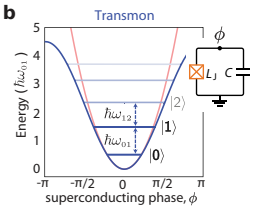
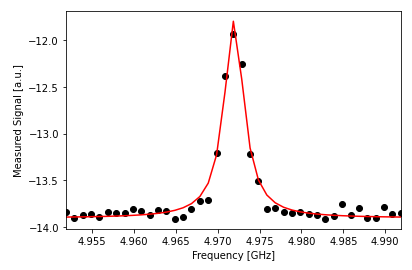
The superconducting Josephson junction is a fundamental quantum oscillator that involves electron (Cooper) pairs tunneling through an insulator layer between two superconductors at very low temperature. Instead of the electrons and holes that determine semiconductor 0 and 1 bits, a Cooper pair is inherently a qubit. For a current of 40 nA, about 1e9 electron pairs result and from a 13 microV, a frequency of 6.6 GHz at 0.015 K. The Cooper pair current results from the specific geometry and materials of the junction as well as the applied voltage but the frequency is always just proportional to the applied voltage. In fact, this junction is a quantum oscillator at that frequency where each excited state includes one additional Cooper pair of electrons at a slightly lower frequency due to anharmonicity.

The basic qubit of a quantum computer incorporates not only the 0 and 1 of a classical bit, but also a quantum oscillation between 0 and 1 of the Cooper pair across a junction. A very common qubit is a particular Josephson junction called a transmon that incorporates a shunt capacitor to make the quantum oscillator more stable. The transmon that oscillates at around 6.6 GHz and so its qubits undergo this same quantum oscillation. 

Another common qubit is the squid, which involves a loop with two Josephson junction. In any case, a qubit is the excitation of just one Cooper pair, 0 -> 1, across a junction at about 200 MHz lower frequency due to anharmonicity. The quantum anharmonicity also means that the 1 -> 2 transition is 200 MHz less that then 0 -> 1 transition. In fact, useable qubits need to have such isolated transitions and so the anharmonicity is what makes the transmon and the squid useful qubits as the figure shows.
However, there is an additional splitting of each level due to the phase or direction of the electron pair across the junction and that splitting reflects the spin or rotation of the qubit as the figure below shows. Much like electron spin emerges from the complementary rotations of electron charge loop oscillation, the complementary rotations of superconducting loop oscillations in the transmon and squid are then a kind of qubit spin.

The charge dispersion of the even(+) and odd(-) states depends on many different factors including biasing the gate ng. Gate bias increases charge dispersion up to 60 MHz as the figure shows.
There are literally dozens of other qubit schemes based on Josephson junctions because there are all kinds of practical considerations for reading, writing, and error checking qubits and, of course, adjusting their couplings. For example, it is desirable to have qubit lifetime long enough to allow for useful computation, but short enough to also be quickly reset. So superposition states result from rotating quantum phase by pi/2 or 90d.

The Google Sycamore chip incorporates 27 squid qubit pairs with 88 transmon couplers in a 6x9 zig-zag grid. There is a stability associated with such complementary qubits that is not unlike the bond between two hydrogen atoms. For example, there are many undesirable couplings among qubits simply due to their proximities. Coupling adjacent qubits with complementary spins forms the basis of a swap gate.

The qubit lifetime, T1, is therefore usually about 10 microsec, which is long enough for reading and still short enough for resetting, which all involve 10 nsec switches. The dephasing time, T2, is due to the entanglement among other qubit states that is necessary for effective computation. This dephasing time is important for quantum entanglement outcomes and is therefore limited by T1. However, it is then difficult to differentiate dephasing from pure decay.

Arrays of coupled qubits then become the molecules of the quantum computer and excitations of those molecules are the qubits. It is the evolution of those qubit excitations from an initial to a final state that is the nature of quantum computation. Eventually, the excitation decays completely into incoherent heat and the whole key is to get a useful result before the inevitable decay to incoherence.

The quantum Fourier transform is perhaps the most fundamental quantum computation that shows quantum supremacy over the discrete Fourier transform of a classical digital computer. Although both quantum and classical FT's decompose a bit sequence into a bit spectrum, the quantum time needed is drastically less than the classical time. While the classical time needed is exponential, the quantum time needed is polynomial.

Below are three qubit sequences along with their FT qubit spectra for a qubit sequence at the Nyquist limit, a sinc pulse, and at the low frequency limit. Unlike a digital FT that evolves in exponential time, a quantum FT evolves from a series of operations in polynomial time to factor odd bit sequences by that evolution. Of course, the larger the number, the greater the number of operations needed to factor the number. Currently, 15 is the largest number that quantum computers have factored because of the current limits of coherence and error.


Saturday, September 4, 2021

Spin as a Loop or 0-Brane String

Unlike a photon resonance between particles, which is a one dimensional D-brane string with Dirichlet boundary conditions, the photon resonance of particle spin has cyclic boundary conditions and so is a 0-brane loop string and not a D-brane string. Since particle spin dimensions do not map directly into 3D space and time, for quantum energy calculations, typically two dimensional Dirac spinors represent spin dimensions distinct from 3D space and time. Since spin resonance energies tend to be much smaller than quantum orbit resonances, this Dirac-spinor separation of variables works very well for many energy calculations that include average spin.

However when instantaneous quantum phase matching is important, describing spin as a 0-brane loop string is then useful since 0-brane loops also show both mass and charge oscillation along with the three D-brane magnetic fibers that take a 4𝜋 rotation to return spin magnetic identity. The figure below shows how the orthogonal grey and cyan spin D-brane fibers do not cross each other when they rotate and therefore maintain their orthogonality.


Closed orbits are also 0-brane spin resonances then represent the many D-brane string resonances of the electron and proton for both electric and magnetic fields. There are many different short-lived D-brane resonances that make up the hydrogen atom states and it is only an average 0-brane resonance that gives a well-defined energy and radius for each state.

Since quantum phase matching is still an issue with the resonance of spin-orbit coupling, the 0-brane spin phase is useful for matching the D-brane orbital phase. In the first excited state of hydrogen, the coupling of the electron spin magnetism to the electron orbit magnetism results in the fine structure of the hydrogen spectrum. The figure shows three of the many different short-lived electron P-type orbital resonances. There is only a well-defined average electron energy and radius for the hydrogen fine structure.


The brane formalism is therefore a very convenient way to show spin 0-brane spin resonance phase coupling with the very different D-branes of orbital resonances. In contrast, Dirac spinors show only the average spin-orbit coupling and do not show the instantaneous quantum phase matching of each QED brane resonance. The 0-brane to D-brane formalism shows the instantaneous phase matching of resonances that even wavefunctions do not represent very well.


Saturday, August 21, 2021

Photon Geodesics as D-Brane Strings

Photon resonance geodesics are the basic quantum exchange bonds responsible for both quantum charge and quantum gravity. While quantum charge photon exchange is a resonance along the geodesic between two bodies, this photon exchange also bonds all bodies to the universe with quantum photon exchange and so is quantum gravity. The attraction of quantum gravity is then the residual attraction due to geodesic shadows of the universe that the two bodies cast on each other along their line of action.

Gravity waves in space and time represent matter action radiation that can then eventually lead to matter action acceleration as well for very massive objects like black holes and neutron stars. Black hole mergers result in large amounts of matter action acceleration and radiation but very little or no dipole radiation because black holes are charge neutral.

Classical relativistic gravity is a scalar force, since it does not depend on direction and so classical gravity attracts bodies together just like charge is also a scalar force that attracts opposite charges together. Nevertheless, both gravity and charge do act along their lines of action between bodies. In contrast to classical gravity motion, charge motion further results in vector force call magnetization that then couples charges together with a force perpendicular to each of their lines of action. 


Since matter-action gravity is really just a version of quantum photon exchange, there is also a quantum gravity vector force also exists. However, gravity motion always couples complementary photon pairs as a quadrupole and so vector gravity couples the motions of stars and would also be perpendicular to their lines of action. In fact, vector gravitization is then the precursor to the dark matter force that couples galaxy stars into a constant rotation.


String theory is a very flexible theory of everything and uses branes as either loop branes or D branes with any number of hidden new dimensions. The "D" stands for Dirichlet boundary conditions as two brane endpoints and not a string loop. String theory can then explain any measurement by adding as many new dimensions or parameters as needed to fit measurements of physical reality.


However, a quantum D-brane string in just one dimension has all of the properties of an electron charge and matter oscillation and so a trivial D-brane with just one dimension is consistent with physical reality without any extra added dimensions. A D-brane electron would actually span the universe and not really be microscopic or hidden either. In fact, a photon and any quantum particle is then also equivalent to a trivial D-brane.


Therefore, such trivial D-branes already make up the causal set universe. Such quantum D-branes have the quantum property of oscillation along their lengths and so a D-brane also represents a photon resonance geodesic between two emitters, say Alice and Bob. Thus, D-branes without any new hidden microscopic dimensions form the basis of a quantum causal set universe and so there is no need for any new but hidden microscopic dimensions.


Alice and Bob in a resonant photon exchange represent a D-brane, but now as the resonance or connection between two Dirichlet endpoints or vertices. Of course, such D-branes can and do span the universe as the CMB, but such D branes actually represent the bonds of quantum photon charge exchange as well. Since all bodies have a very large number of D-branes that bond them to the universe, attractive gravity between two bodies is actually a result of the universe collapse and so the universe is not expanding.


After CMB excitation, the Alice-Bob D-brane resonance does not reveal any cause or effect and so this universe is not yet real. A black hole absorption occurs at Bob is what reveals Alice as the emitter precursor and Bob as the outcome absorber. The black hole absorption sets the arrow of time and is what makes the universe real.


There are many things about the universe that D-branes reveal. For example, bodies shadow each other’s D-brane bonds with the universe along their lines of action and so gravity is simply a result of these shadows of the universe collapse as the diagram below shows. String theory is just as fun as causal set theory... however, loop quantum foams do not have branes and so are no as much fun... Tejinder Singh, though, has a great TOE that does use path integrals and cosmic time along with octonions... but we need to get spin involved somehow as well...


Social bonds are also D-brane resonances that couple expressions and between people that result in attraction as shown below. Once again, CMB precursors drive all D-brane excitations and black hole outcomes drive all D-brane decays, providing the arrow of time. It is the arrow of time that makes reality real...