Search This Blog

Monday, October 10, 2022

Quantum Gravity of Discrete Aether

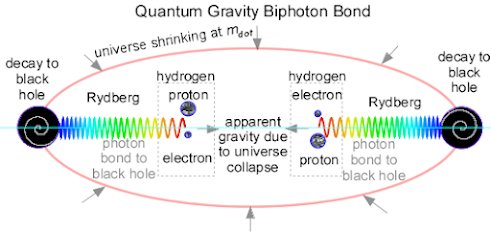
Quantum gravity is just a residual force of the quantum causal set, which exists outside of space and time. Instead of matter and action in space and time, space and time emerge from matter action of a causal set. Space as distance and time as relative quantum phases of the quantum photon exchange bonds emerge from neutral bodies like hydrogen atoms. Beyond a certain distance, about 70 nm for two hydrogens, quantum gravity is greater than the dispersion of quantum photon exchange. Quantum gravity between two hydrogen atoms is just the dispersion of quantum photon exchange of each atom with the rest of the universe.

Gravity relativity emerges from the fundamental equivalence of mass and energy for particles that exist in relativistic spacetime. To first order, the Lorentz invariance of the speed of light to velocity of a particle distorts space and time by the classic sqrt(1/(1 - v2/c2)). There are higher order terms that converge to the Einstein tensor as proportional to the energy-momentum tensor,

All of the complexity of general relativity reduces to this tensor equation and yet there is no accepted quantum gravity in spacetime. This is because each particle of matter introduces a singularity at r = 0 in spacetime that precludes a quantum electrodynamics exchange particle for gravity. 

One consequence of GR is the black hole singularity that are widely accepted in general relativity but have no quantum meaning in QED.  A black hole has mass and spin just like any other particle in the quantum causal set universe and black holes bond to the universe with photon exchange just like all matter particles. Thus, black holes are just another matter particle in a quantum causal set, which is about each matter body bonding to the rest of the universe with quantum photon exchange.

The space between two hydrogens emerges from the strength of the quantum photon exchange interaction between two hydrogen atoms. The time for the two hydrogens emerges from the relative quantum phases between the two hydrogen atoms. Ironically, space and time emerge from quantum photon exchange and at large separations, the quantum gravity photon exchange of each atom with the universe then dominates over just quantum photon exchange between the two atoms.

Thursday, July 21, 2022

Large Scale Structures in the Cosmic Microwave Background

 The cosmic microwave background (CMB) multipole analysis shows an angular scale consistent with a combination of 4.9% ordinary matter, 27% dark matter, and 68% dark energy expanding at 68 km/s. 

However, this cosmology does not include quantum gravity at all and so there is no way to measure the absolute expansion rate of the universe. Although the small scale CMB structures are consistent with the cosmology without quantum gravity, there is an inconsistency in the large scale CMB structures of the universe as the figure shows.

A collapsing universe cosmology shows quantum gravity and a universe of ordinary matter that is only 1.1e-7 kg/kgAether, 8.7e-69 kg/aether, and 8.4e-61 kg.kgAether action collapsing at the rate of 77 km/s. The universe collapse quantum cosmology shows both a static gravity as well as a radiant vector gravity  and the large scale CMB structures are consistent with radiant vector gravity.


Since the collapsing universe quantum gravity bonds with quadrupole biphoton exchange, there is now a vector component to gravity along with the Newtonian scalar gravity. Vector gravity couples the relative motions of stars much like magnetism couples the relative motions of charge. Since universe collapse is a matter decay that is the source of gravity, the matter decay of star radiation couples star motions as well as star convection.

Sunday, June 12, 2022

Scalar Static Matter and Vector Radiant Matter Gravity

Since matter-action gravitons are biphotons, which are entangled photons, there is not only scalar gravity due to static matter graviton shadows, but also a radiant vector gravity due to radiant matter. In other words, the radiation of stars entangles their motions with other stars and this entanglement results in radiant vector gravity.

Here is a diagram that shows scalar gravity shadows that results from the matter body bonds to the universe along with the radiant vector gravity that transfers momentum from inner to outer stars. Radiant vector gravity transfers momentum from stars inside the CofM to stars outside the CofM. This radiant momentum transfer is what keeps spiral galaxies rotating at constant velocity instead of at their Keplerian velocities.

The plot below shows the velocity profile of the Milky Way along with the observed Sun as opposed to the Keplerian Sun. The actual Sun velocity is about 29% greater than the Keplerian Sun velocity reported by Sofue et al, 251 vs. 194 km/s. The Keplerian gravity force at the Sun at 8.0 kpc is 8.4e14 kg m/s^2, which is consistent with a Sun velocity of 194 km/s as opposed to the actual Earth velocity of 251 km/s. 

However, there is a radiant vector gravity force in matter action that couples star motions and transfers momentum from inner to outer stars. The Sun radiance is 4.2e9 kg/s and results in a radiant vector force of 4.2e9 kg/s x 2.51e5 m/s / 2 = 5.5e14 kg m/s^2. Thus the scalar plus vector gravity of the Sun is actually 1.4e15 kg m/s^2, which is now consistent with the 29% increase in Sun velocity as sqrt(1.4e15/8.4e14) = 1.29. Radiant vector gravity now completes the virial energy theorem for galaxies without any need for dark matter.

Thus, radiant vector gravity is completely consistent with the momentum transfer that occurs from stars inside to outside the CofM for constant galaxy rotation. Radiant vector gravity completely explains galaxy rotation without any dark matter at all.

The figure above shows the biphoton shadows of scalar gravity along with the radiant vector gravity momentum transfers from inner to outer stars. Since the Sun is quite a bit more luminous than the average MW star, the Sun rotates faster than the galaxy average. The MW average rotation velocity is 204 km/s at r = 8 kpc while the Sun rotation is 251 km/s, which suggests that the Sun is 251 / 204 = 23% greater than the average stellar MW luminosity. 

Since the average stellar luminosity is 2.1e10 Lsun / Nstars, this result further suggests that the number of MW stars is 91 billion as Nstars = 2.1e10 / 0.23, which assumes that MW stars at r = 8.0 kpc are representative of the whole MW. This MW 91 billion star estimate is at the lower end of the typical 100-400 billion star number estimate often cited.

Radiant vector gravity is also consistent with the Bullet Cluster 1E 0657-56 galaxy collision that displaced large gas clouds that were 10-15% of galaxy matter from the two galaxies shown. Despite the matter displacement of 10-15%, the weak-lensing contours of each of the two galaxies still align to the galaxy's radiant stars. These results show clearly that vector radiant gravity as well as static scalar gravity are both lensing the Bullet cluster.


https://astrobites.org/2016/11/04/the-bullet-cluster-a-smoking-gun-for-dark-matter/


Wednesday, June 1, 2022

Graviton Noise of Quantum Gravity

We live in an ocean of graviton noise and so it is graviton noise that is what makes things happen in our quantum reality. Entangled photons, biphotons, make up gravitons and are what bind each body to the universe of black holes. Black holes are the penultimate heat sink for all of our reality and what we see as gravity attraction is actually just the collapse of the universe matter and the interaction of photon geodesics.

The destiny of all black holes is then a single black hole that is the destiny of this cycle of the universe collapse. In other words, bodies do not really bond to each other with gravity. Instead each body bonds to the universe and we see gravity attraction as the universe collapse of photon geodesics.

The graviton noise of the universe photon geodesics is what makes all wavefunctions collapse and so graviton noise is also what makes reality real...

Blackholes eventually anchor all CMB photons and it is biphoton eternal exchange that results in the apparent gravity between blackholes. What we call gravity photon deflection is actually the deflection of photon geodesics and so gravity lenses are really photon geodesic lenses...


Wednesday, February 23, 2022

Discrete Aether Time Pulse

The discrete aether pulsed universe has a nice symmetry between its time pulse and the hydrogen time pulse defined by the Bohr time. The universe pulse is a 13.9 Byr sinc function of cosmic time with a Fourier transform that is dominated by the aether particle spectrum. The hydrogen pulse is a sinc function of cosmic time with a Fourier transform mass spectrum of the total universe mass that is 90% hydrogen mass.


While the aether particle mass determines the universe pulse in cosmic time, it is the total universe mass that determines the hydrogen pulse also in cosmic time.


Sunday, February 20, 2022

Discrete Aether Predictions


1) In contrast to the dependence on radius for Newton's gravity orbit velocities, galaxy rotation velocities are constant do not depend on distance from the galaxy center. Science explains this discrepancy by adding a cold, dark halo of invisible dark matter around each galaxy disk.

In the matter-action pulsed universe, universe matter decay determines gravity and so the extra matter decay as star radiation results in a star matter waves. These star matter waves couple star motions as a vector gravitization that is consistent with radial independent galaxy rotation as the plot shows.

2) Star matter waves couple into galaxy spiral density waves that periodically decelerate and accelerate the orbit velocity of the Sun in its orbit around the galaxy.

3) Moreover, the galaxy spiral matter waves correlate with known matter extinctions as the plot below shows.

4) The discrete aether pulse universe is in mass decay and therefore also in force growth, which means that measuring mass with an action will not show either matter decay or force growth. However, certain kinds of measurements of mass do show the decay and the international kilogram standard, IPK, has decayed over the last 100 years relative to its many secondary standards as the plot shows.

The secondary standards are routinely cleaned with use and the cleaning process results in adding mass so as to keep the secondary standards constant mass. The IPK primary is not subject to the same periodic cleaning and is only been used three times as the plot shows. The matter decay of the IPK matches that of the pulsed universe, which is the collapse of aether equivalent to charge force.

5) Earth’s spin as the length of the day varies over the course of the year because of a variety of reasons. There is also an average long term decay in earth’s spin as the plot shows. Science attributes all of this decay to tidal friction of the oceans, but the pulse universe predicts about one half of this decay is intrinsic to the universe pulse decay.

6) There is a universe pulse decay line that is consistent with many measurements of decay at the slope of 0.255 ppb/yr. In particular, the msec pulsar decays, earth spin decay, earth moon orbit growth, and Andromeda galaxy to Milky Way galaxy separation decay.

7) The sunspot cycle has been measured for 400 years as a 11.6 year variation in sunspot number per month as the plots below show. There is currently no explanation for the sunspot cycle, but with the universe pulse decay, there are matter waves associated with the star decay.

Star decay produces star matter waves that couple the motions of stars with a vector gravitization much like charge motions are coupled with vector magnetization. The two stars, Procyon and Cygni-61, are both 11.6 lyrs away from our sun, which couples their motions and affects the Sun’s convection with an 11.6 year period.

Sunspot activity went into a hiatus around 1680 as the plot shows, which is consistent with the Cygni-61A/Cygni-61B periapsis or closest approach at that time. Cygni-61 is a double star and so its double star orbit plays a role in the sunspot activity of our Sun. Thus, the 678 yr orbit of the Cygni-61A/B double star will reach apeosis again in the year 2358. The Procyon A/B double star has a 40.8 yr orbit and shows up as a 40.8 year shift in sunspot peak and intensity.


8) The spectrum of muonic hydrogen in the plot does not agree with predictions from quantum theory and H spectroscopy shown shifted in the plot. However, the muon lifetime is only 2.2 micros and in the discrete aether pulsed universe, the short muon lifetime is an increased matter decay rate that shifts its spectrum as shown. With the muon decay rate included, the muon and hydrogen spectra now agree as the plot shows.

9) Since matter decay is equivalent to a force, discrete aether predicts that a matter decay of 83 MW/kg is equivalent to the 1.0 G force of earth’s gravity. The sun radiance is just 1.9e-4 W/kg and it would take a 1 kg U reactor pile 12,000 K to achieve 83 MW/kg. This is equivalent to a 1 kg U shell 22 m diameter radiating at 1,000 K, which is below the U melting point.

10) Matter decay couples the Sun radiance to the galaxy spiral density waves to accelerate the Sun to its present 251 km/s from the 204 km/s spiral wave velocity, and increase of 47 km/s over 49 Myrs. This is an average force of 4.1e-7 G that acts over 49 Myrs and predicts that a radiant source can surf on galaxy spiral waves as well.